ComplyMint: Designing Compliance That Doesn't Feel Like Compliance

There's a quiet problem sitting inside every Indian D2C brand, fintech startup, and SaaS company right now. The Digital Personal Data Protection Act, 2023 has set a hard deadline — and most businesses know they need to comply but have no idea where to start. The tools that exist are either built for enterprise legal teams or too complex for a founder managing five things at once.
ComplyMint was designed around one principle: compliance should feel like a product, not a punishment.
---
The Design Philosophy
Most compliance tools look like they were built by lawyers for lawyers — dense dashboards, legal jargon, walls of text. ComplyMint takes the opposite approach. The visual language borrows from tools like Linear and Notion — clean whitespace, minimal chrome, one task per screen. The color system is intentionally restrained: a single primary blue (#2563EB), semantic reds and greens only for compliance status signals, and a white background that keeps the focus entirely on the user's data.
Every screen was designed to answer one question: what does the user need to do right now? Not what they might need someday. Not a feature showcase. Just the next action, clearly presented.
---
The Compliance Score — Making the Abstract Tangible
The hardest design challenge in any compliance product is turning regulatory obligation into something a non-lawyer can understand and act on. ComplyMint solves this with a single circular score (0–100%) at the center of the dashboard — color-coded red, orange, or green — paired with a live penalty exposure figure in Indian Rupees.
A founder who sees "₹5 Crore estimated exposure" understands the urgency immediately. No legal brief required. The score updates in real time as the user resolves action items, creating a feedback loop that makes compliance feel like progress rather than obligation.
---
The Five Core Modules
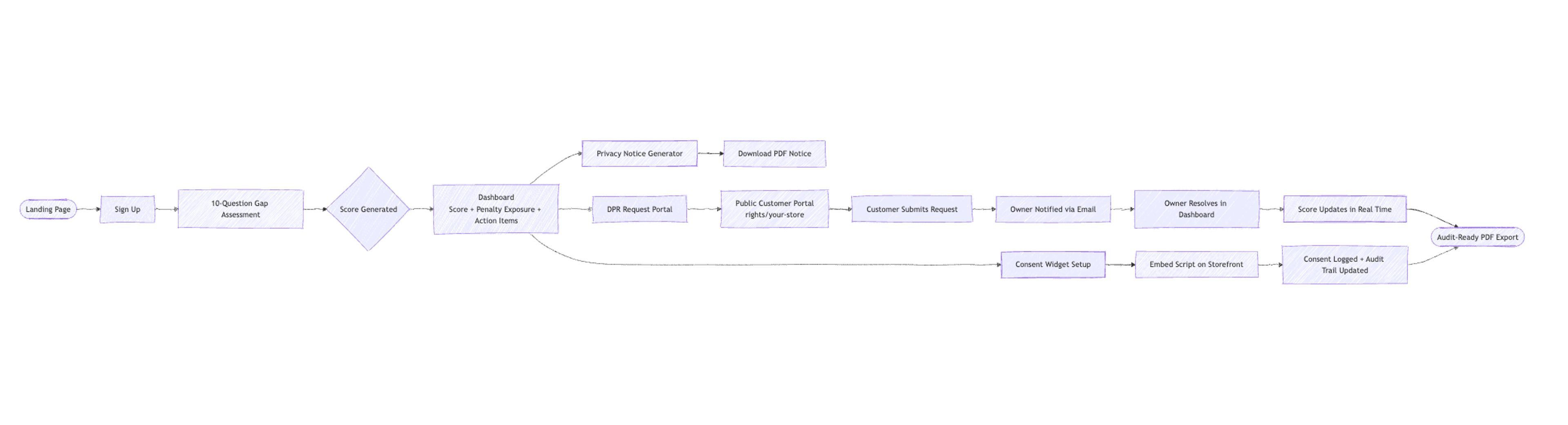
Gap Assessment is a ten-question wizard — one question per screen, large tap-friendly answer cards, no Next button needed. Selecting an answer auto-advances. The entire assessment completes in under three minutes and generates a prioritized action list on the final screen.
Privacy Notice Generator uses a two-column layout: form on the left, live document preview on the right. Every field the user fills updates the notice in real time. The output is a fully formatted, DPDP-compliant privacy notice ready to publish or download as PDF.
DPR Request Portal is a public-facing page (no login required) where customers submit data access, correction, or deletion requests in four taps. On the owner's side, each request shows a live 72-hour countdown timer — green when safe, orange when urgent, red when overdue.
Action Items Checklist breaks down every compliance gap into plain-English tasks grouped by priority. Completing a task updates the compliance score immediately with a brief confirmation — small moments of progress that keep users engaged rather than overwhelmed.
Consent Widget is a single JavaScript snippet that drops a lightweight consent banner onto any storefront. Pure vanilla JS, no dependencies, loads in under 50ms. Every consent event is timestamped and logged to an immutable audit trail.
---
Designed for the Indian SME Reality
Three design decisions were made specifically for the Indian market.
First, all customer-facing text — privacy notices, consent banners, DPR portal instructions — is available in Hindi, Tamil, and Telugu out of the box. The DPDP Act requires notices in languages users understand. ComplyMint makes that a one-toggle decision, not a translation project.
Second, the entire interface is mobile-first. Dashboard cards stack vertically below 768px. The DPR portal was designed assuming most customers will open it on a phone — large tap targets, minimal form fields, single-column layout.
Third, all data is stored on servers in the Mumbai AWS region. Data residency in India isn't a premium feature — it's the default. For a product selling compliance, being non-compliant about your own data storage is not an option.
---
What Compliance Actually Looks Like
ComplyMint doesn't make compliance invisible — it makes it manageable. The design goal was never to hide the work. It was to break the work into steps small enough that a solo founder, a D2C brand's ops person, or a CA managing multiple clients could move through them without needing a lawyer in the room.
The May 2027 deadline is not far away. The businesses that get ahead of it won't be the ones who hired the most expensive consultants. They'll be the ones who found a tool that made the right next step obvious — and took it.
---
ComplyMint is currently in early access for Indian D2C brands and SaaS companies.


